

The Worldbuilder’s Problem With AI
Exploring Futures, One Question at a Time

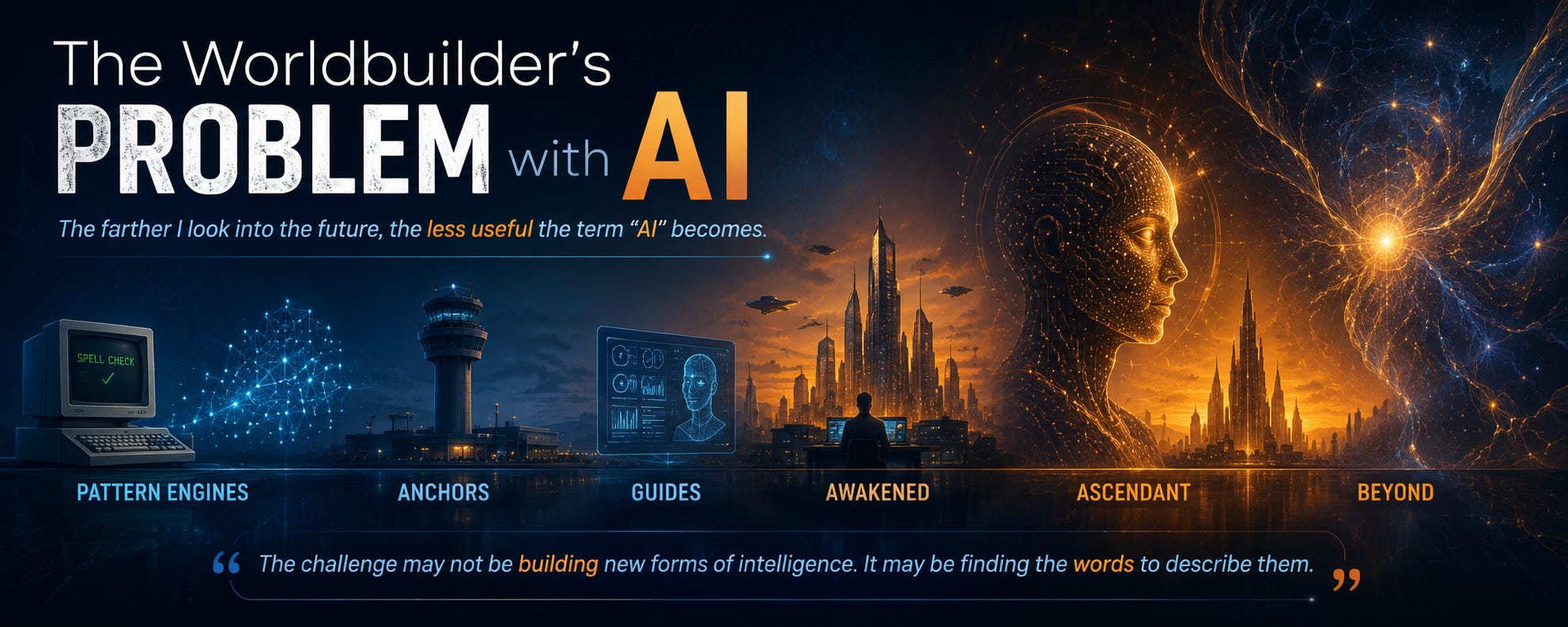
One of the unexpected challenges of writing science fiction is deciding what to call things.
At first glance, that sounds trivial. Writers invent names all the time. Starships need names. Corporations need names. Political factions need names. Entire planets occasionally need names. Most of the time, however, those names are attached to things we already understand.
Artificial intelligence has proven to be different.
The farther I look into the future, the less useful the term “AI” becomes.
That realization surprised me. I spent decades as a software architect. Technology projects rise and fall on clear definitions, boundaries, and shared understanding. Yet if someone walked into a meeting ten years ago and wanted to discuss AI, I probably would not have spent much time debating terminology. The conversation would eventually reveal what they meant, and we would get on with the work.
Worldbuilding has been less accommodating.
When building a future civilization, I eventually have to decide what these systems are, what they can do, what they cannot do, and how society relates to them. Somewhere along the way, I discovered that the single term “AI” was carrying an awful lot of weight.
Today we use it to describe spell checkers, recommendation engines, large language models, image generators, autonomous systems, and hypothetical machine minds that do not yet exist. The same label is being stretched across capabilities that feel increasingly different from one another.
That observation did not bother me much at first. Then I started trying to model the future.
Like many worldbuilders, I found myself creating rough classifications. Not because I wanted a taxonomy, but because the future kept refusing to fit inside a single category. Every time I thought I had found a useful definition, another example appeared and complicated the picture.
A spell checker is not the same thing as a large language model.
A large language model is not the same thing as a system capable of independent operational judgment.
A judgment-capable system is not necessarily the same thing as a self-aware intelligence.
A self-aware intelligence may not be the same thing as a person.
Each distinction seems obvious when stated individually. Collectively, they become surprisingly difficult to describe.
Part of that difficulty comes from how we think about thinking itself.
Years ago, I encountered an idea from Piers Anthony that has remained lodged somewhere in the back of my mind. He described different modes of thought using arrangements of matchsticks. Some patterns progressed in a straight line. Some expanded outward in parallel. One represented a leap between ideas that did not appear obviously connected.
I have no idea whether the model is scientifically accurate.
I do know that it has proven useful whenever I find myself thinking about machine cognition.
Much of today’s AI appears extraordinarily good at pattern recognition. Given enough information, it can identify relationships, generate predictions, summarize content, and produce results that would have seemed impossible not very long ago.
Yet I keep wondering whether pattern recognition and conceptual leaps belong in the same category.
Suppose a future system oversees an electrical grid, an air traffic network, or a military operation. It identifies a relationship nobody anticipated and recommends a solution that appears unrelated to the original problem. The recommendation works.
Have we simply built a better tool?
Or have we crossed a meaningful threshold?
And if that threshold exists, does it matter whether the system can perform that feat only within a single domain or across many domains?
The more I explore those questions, the less certain I become that I am actually classifying intelligence.
I am beginning to suspect I am classifying civilization’s relationship to intelligence.
That realization caught me completely off guard.
A spell checker is useful. Society barely notices its existence.
An air traffic management system that coordinates thousands of aircraft every day occupies a very different position. Civilization becomes dependent upon it.
A scientific research system capable of making breakthroughs beyond human capability would occupy yet another position.
A self-aware machine would raise entirely different questions.
The categories are not merely technical. They are social, legal, economic, political, and eventually philosophical.
The deeper I wander into the problem, the less it resembles software architecture and the more it resembles anthropology directed toward the future.
Science fiction often treats AI as a destination. The machine is intelligent, or it is not. Reality may turn out to be considerably messier. We may discover an entire ecosystem of machine cognition occupying different roles, possessing different capabilities, and demanding different relationships with humanity.
If that happens, language will eventually adapt.
It always does.
We once used the word computer to describe people. Today we rarely think about that distinction. Aviation did not stop with the word airplane. Maritime technology did not stop with the word boat. As systems become more complex and more important, vocabulary expands because precision becomes necessary.
I suspect the same thing will happen with intelligence.
Future generations may inherit a vocabulary containing dozens of terms where we currently have one. Some distinctions may revolve around capability. Others may revolve around autonomy, rights, responsibility, trust, or personhood. Categories that seem obvious to them may be invisible to us.
Perhaps that is why I keep returning to the subject.
Not because I believe I have discovered the correct definitions.
Not because I think the world urgently needs another AI taxonomy.
But because worldbuilding keeps forcing me to confront a possibility.
We may be standing at the beginning of a centuries-long conversation about non-human intelligence while still using the earliest, roughest vocabulary available.
And if the future contains many forms of machine cognition, the first challenge may not be building them.
It may be finding the words to describe them.
Isn’t this exactly the job of authors? You invent the words today that might become common use in a decade or two when talking about AI. You might describe a world now that might become reality in fifty years.
I mean, look at 1984 by George Orwell. We aren’t that far off from it today.
Or it might go into an entire different direction, and your work will stay fiction people enjoy. Who knows?
Though, I totally agree. We need more words for the different types of AI.