

When Medicine Becomes Maintenance
Exploring Futures, One Question at a Time

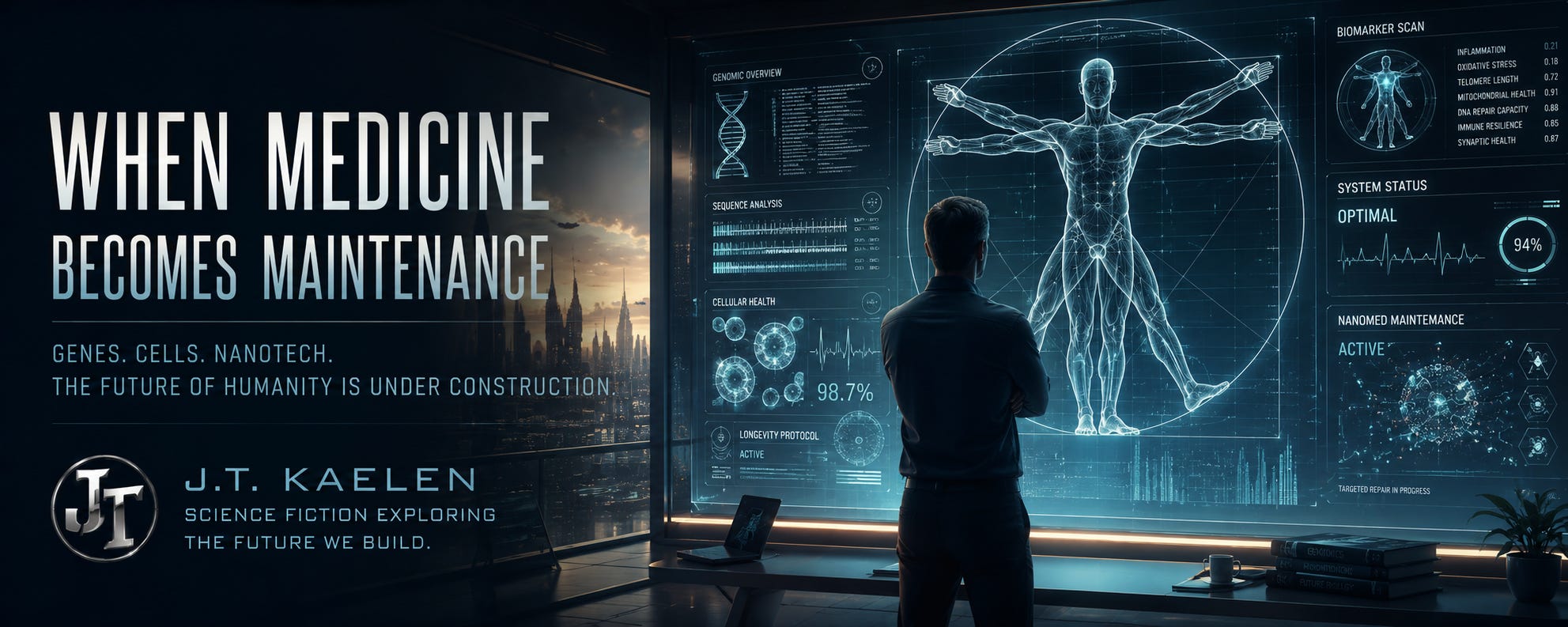
One of the questions that keeps finding its way into my fiction is deceptively simple:
What happens when medicine stops treating disease and starts maintaining the human body?
For most of human history, medicine has been reactive. Something breaks, becomes infected, grows where it shouldn’t, or simply wears out. Then we attempt to intervene. Sometimes we succeed. Sometimes we buy time. Sometimes we lose the fight altogether.
Even our greatest medical advances largely follow this pattern. We diagnose. We treat. We recover, if we’re fortunate.
Yet when I look at developments in genomics, artificial intelligence, robotics, and nanotechnology, I find myself wondering whether we are slowly approaching a different model entirely.
Imagine a future where your genome is completely mapped and understood. Not merely sequenced, but understood in the same way a mechanic understands an engine or an engineer understands a bridge. Every inherited weakness, every susceptibility, every beneficial trait, every subtle interaction becomes part of a continuously evolving picture of your biological health.
Now imagine pairing that understanding with increasingly capable AI systems. Instead of comparing your health against broad population averages, those systems compare you against yourself. They know what healthy looks like for your body. They recognize changes years before symptoms appear. They identify patterns invisible to physicians because they are measuring millions of variables simultaneously.
At that point, medicine begins to look less like emergency response and more like preventive maintenance.
The next step is where science fiction starts becoming interesting.
Suppose future therapies can routinely repair damaged DNA, replace failing cellular machinery, remove senescent cells, restore degraded tissues, and correct errors as they occur. Whether those repairs come from advanced gene editing, programmable biological systems, microscopic robotic devices, or some combination of technologies we haven’t yet imagined is almost secondary to the question itself.
What happens when damage no longer accumulates as quickly as it does today?
The first answer most people reach for is longer life.
That answer is probably correct, but it is also the least interesting.
Longer life is simply the visible consequence.
The real changes would ripple through every aspect of civilization.
Education might cease being something concentrated in the first twenty years of life. Careers could span multiple professions and multiple centuries. Retirement, at least as we currently understand it, may become an artifact of a shorter-lived age. Family structures could evolve in ways that are difficult for us to predict because they emerged in response to lifespans that no longer exist.
Even ambition changes.
Many of us make decisions based on an awareness that time is limited. We choose which dreams to pursue, which skills to develop, and which risks to take because we know there are only so many decades available to us.
What happens when that assumption begins to weaken?
Would people become more adventurous because they have more time? Or more cautious because they have more to lose?
Would society become more stable? Or more stagnant?
Would wisdom accumulate?
Or would old mistakes simply survive longer?
These are the questions that fascinate me as both a science fiction writer and a student of the future.
The technologies themselves are certainly important. Genomics continues advancing. AI capabilities improve each year. Robotics becomes more precise. Nanotechnology gradually moves from theory toward practical application. Together they suggest a future that may be very different from the one most of us inherited.
Yet the technology is not the story.
People are.
The most interesting question is not whether humanity can extend healthy lifespan.
The most interesting question is what humanity becomes if we succeed.
That is where science fiction becomes useful. Not because it predicts the future, but because it gives us a place to explore possibilities before they arrive.
Whether those possibilities emerge in fifty years or five hundred, I suspect the underlying question remains the same.
If we are given more healthy years, what will we choose to do with them?