

When the Book Starts Looking Back at You
JT's Weekly Update

NOTE: I am brand new to writing and releasing updates. This is more of an experiment as the book was released last month. Needless to say, I will be endeavoring to put out a weekly update moving forward. Hopefully on Sundays or Mondays.
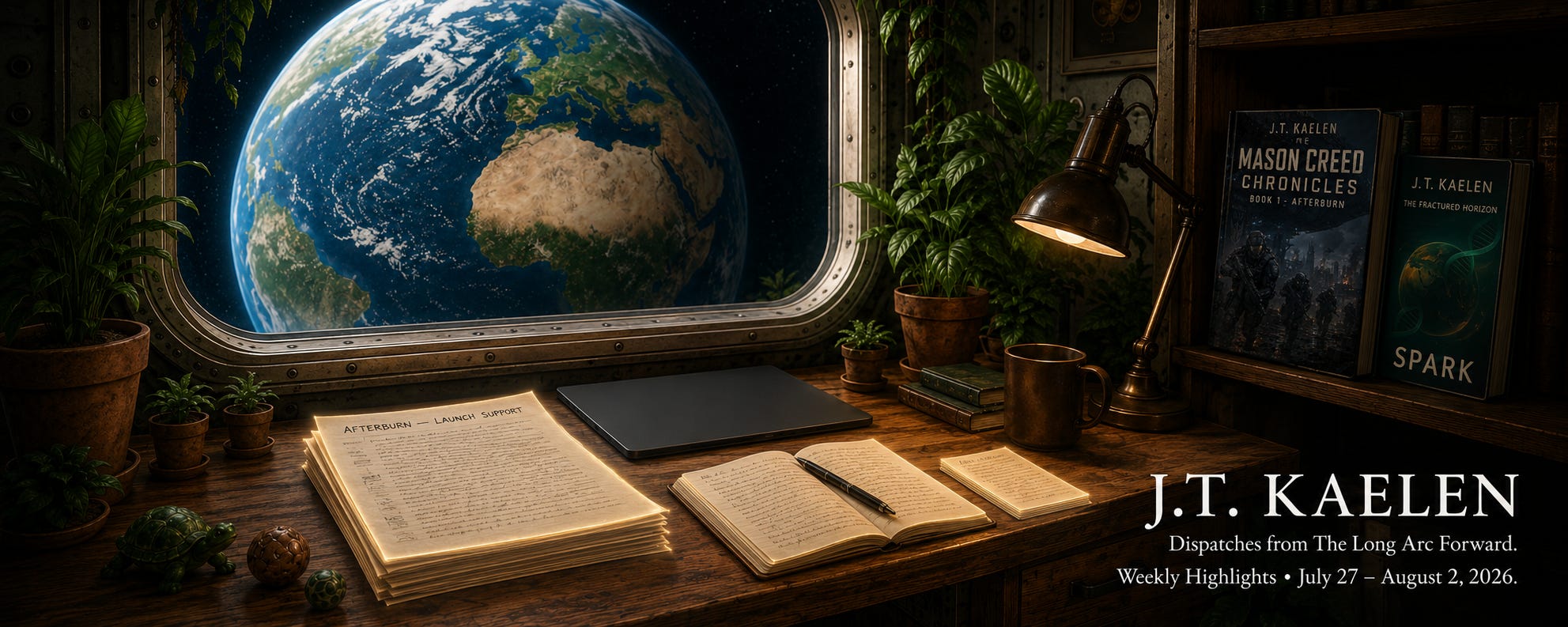
There’s a particular phase after a book launches where you stop thinking about it as yours and start seeing it as something that belongs to the people reading it. Afterburn has been out since July 10th, and the shift is settling in. The manuscript that lived on my hard drive for months — through four editorial passes, continuity fixes, front-and-back-matter builds — is now a real thing sitting on real shelves. This week I started building the next layer of launch support around it: a structured newsletter and a drafted “Next Book” announcement piece, early groundwork for how the series keeps the readers informed beyond the first release.
It’s a strange feeling, moving from “is this chapter working?” to “how does this book introduce itself to someone who’s never heard of Mason Creed?” Different muscles entirely. But the story earned its way here, and the work now is making sure the bridge between my workshop and your bookshelf holds up.
Elsewhere in the Universe
Ghost Ledger, Book 02 in The Mason Creed Chronicles, continues to build momentum from recent work. Chapter 01 has a full draft, outlines run through Chapter 10, and the plot architecture is solidifying. If Afterburn is the book learning to live in the world, Ghost Ledger is the book still figuring out who it is. (Who says “if X then Y” is stricly an AI thing?!)
Over in The Fractured Horizon, Spark is mid-draft at Chapter 9 with worldbuilding groundwork laid for Chapter 10. The book is on pause while I finish an infrastructure cycle (more on that in a second), but I know where the story is going, finally. Sometimes the best thing you can do for a manuscript is leave it alone for a week and let the subconscious do its job.
Behind the Curtain: Building the Author’s Workshop
I also did something this week that sounds boring but might actually be the most important work I’ve done in a month: I built a formal voice profile for JT Kaelen.
Here’s why that matters. I use AI tools in my writing workflow; not to write the books, but to support the massive operational overhead of maintaining multiple series, tracking continuity across dozens of characters, and generating first-pass drafts of worldbuilding documentation. Those tools are only useful if they understand how I write. “Sound like me” is not an instruction. A voice profile, how my sentences move, what I reach for, what I avoid, where the rhythm breaks, that’s a pattern I can stress test with.
The rest of the infrastructure work this week was less glamorous but equally necessary: migrating every active project into a consistent operating format, formalizing the journaling system, archiving old material from The Fractured Horizon‘s earlier drafts. The kind of workshop clearing you do so that the next hundred chapters don’t trip over cables left on the floor.
That’s where things stand. Afterburn is out in the world, Ghost Ledger is finding its shape, and Spark is resting before the next push. More next week.
— JT
Quantum Fracture Creative Group | Amazon Author Page | Substack